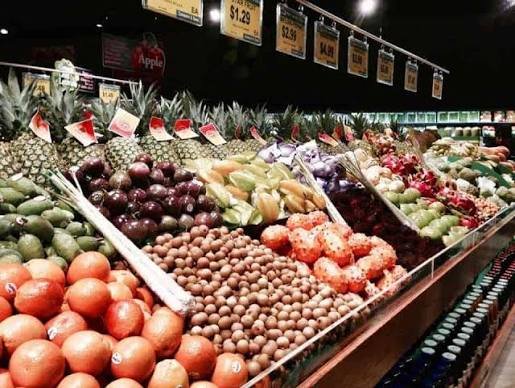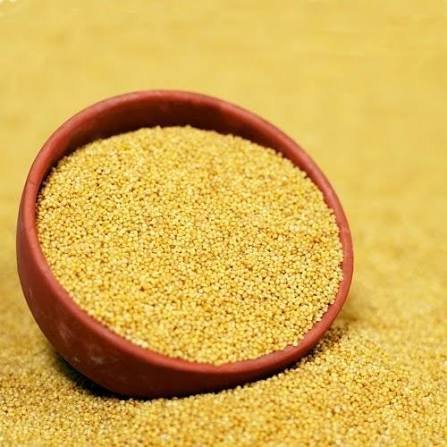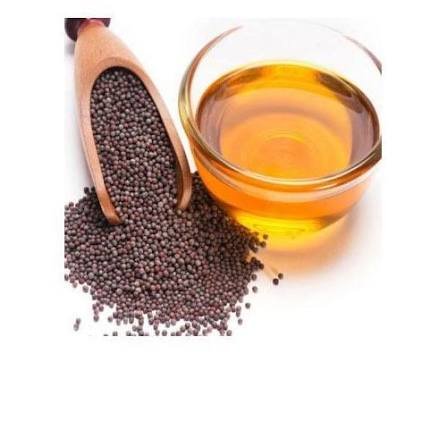
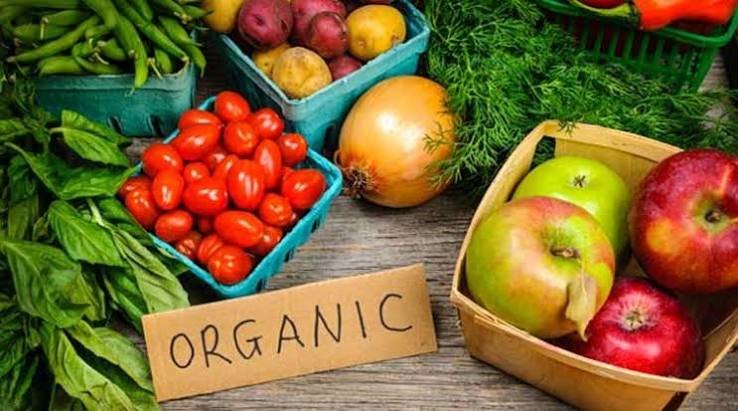

Organic groceries are becoming easier to find in India, but they are also usually more expensive. Walk into a supermarket or browse an online grocery store and you may find organic atta, rice, dals, vegetables, fruits, milk, ghee, spices, oils and even snacks sitting next to their regular versions.
That creates an obvious question: which organic foods to buy first in India – if I cannot afford to buy everything organic?
The good news is that you do not need to replace your entire grocery basket.
A more sensible approach is to spend your organic-food budget on items your family eats frequently, in meaningful quantities, and where you can verify that the product is genuinely organic.
This organic food priority list for India will help you decide where to spend ₹1,000, ₹2,500 or ₹5,000 extra each month without turning grocery shopping into an expensive exercise in perfection.
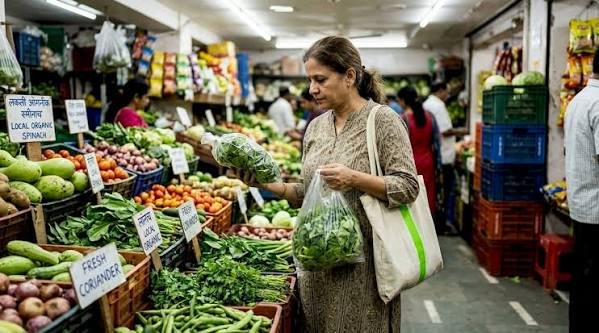
Quick Answer: Which Organic Foods Should You Buy First in India?
If your budget is limited, a practical priority order is:
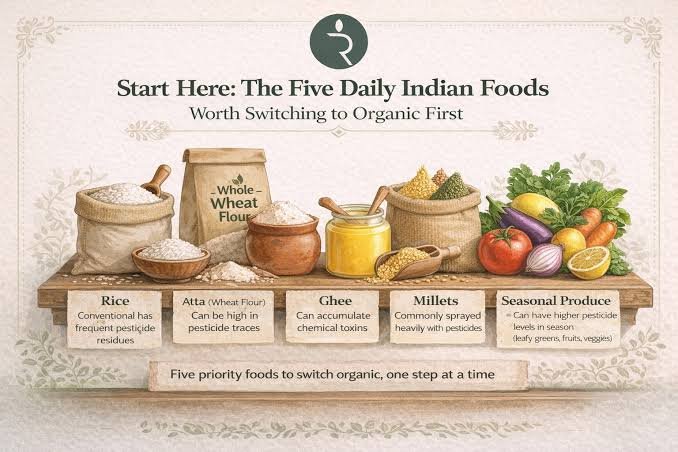
- Staples eaten every day – atta, rice, millets and frequently used dals.
- Frequently eaten vegetables with edible skins or leaves – especially leafy vegetables, tomatoes, chillies, capsicum and herbs when certified organic alternatives are available at a reasonable premium.
- Frequently eaten fruits that are consumed with the peel – according to your family’s actual consumption rather than an imported international list.
- Cooking oils used regularly – particularly if you can buy a reliably certified product from a transparent producer.
- Frequently used spices – especially whole spices and powders bought repeatedly.
- Milk and dairy – if certified organic dairy is affordable and dairy forms a large part of your household diet.
- Occasional foods – dry fruits, speciality grains, packaged snacks and expensive imported organic products can generally come later.
This is not an official government ranking. It is a budget-prioritisation framework based on how much and how often a food is consumed, how it is eaten, how transparent its source is and how large the organic price premium is.
Scientific reviews generally find that organic food consumption can reduce exposure to pesticide residues, but evidence does not show that every organic food is automatically more nutritious than its conventional counterpart. (PubMed)
That distinction is important when deciding which organic foods to buy first in India.
Why an All-Organic Diet Is Not Necessary
Organic shopping can easily become an all-or-nothing decision.
It does not have to be.
A family that replaces the foods it consumes every day may get considerably more value from its budget than one spending the same amount on organic quinoa, imported berries and expensive organic snack foods eaten twice a month.
Research comparing organic and conventionally produced food is nuanced. Organic produce tends to have a lower incidence of detectable pesticide residues, but studies have not demonstrated consistent nutritional superiority across all foods. (PubMed)
So instead of thinking:
Organic = good and conventional = bad
think:
Where will spending extra on organic make the biggest difference to my household’s overall food basket?
That is the basic idea behind organic shopping on a budget.
Five Factors for Setting Your Organic Food Priorities
Before paying extra for an organic version, consider five things.
1. Frequency of Consumption
Start with foods you eat every day.
Suppose your family consumes atta twice daily but strawberries three times a year. Even if strawberries appear on an international pesticide-residue list, switching your everyday atta may affect a much larger proportion of your annual food consumption.
Frequency matters.
2. Quantity Eaten
Frequency and quantity are related but not identical.
You might use turmeric every day, but perhaps only a few grams at a time. Rice, atta, vegetables and milk may be consumed in much larger quantities.
That is why an organic food priority list in India should consider total consumption rather than simply identifying foods on which pesticides may potentially be used.
3. Whether the Skin or Leaf Is Eaten
Produce eaten whole deserves greater consideration than produce where a thick, inedible outer layer is routinely discarded.
Leafy vegetables and herbs, for example, are eaten almost entirely.
But this is only one consideration. Edible skin does not automatically mean that a food is unsafe when conventionally grown.
4. Source Transparency
A trustworthy conventional farmer can sometimes be a better purchasing choice than an expensive packet carrying vague words such as “natural”, “farm fresh” or “chemical free”.
For packaged organic food, look for recognised certification rather than relying only on marketing language.
FSSAI’s Jaivik Bharat consumer guidance identifies the Indian organic certification framework, while APEDA explains that India operates certification through systems including the National Programme for Organic Production (NPOP) and PGS-India. (APEDA Organic)
The Jaivik Bharat portal also allows consumers to search information about organic food operators and products.
5. The Price Difference
Finally, compare the actual premium.
If regular atta costs ₹50 per kg and the certified organic option costs ₹70, the difference is ₹20.
If another premium brand costs ₹160 simply because of elaborate packaging, paying that extra amount may not provide proportionately greater value.
Organic shopping on a budget is about allocating money intelligently, not automatically choosing the most expensive packet.
Priority Group 1: Frequently Consumed Organic Staples
For many Indian households, the first place to consider upgrading is the everyday staples cupboard.
Think about what your family actually eats: wheat atta, rice, ragi, jowar, bajra, dals, rajma, chana or other regularly consumed grains and pulses.
The argument for prioritising these foods is simple: volume.
A household may finish several kilograms of atta or rice every month. Switching even one staple therefore converts a significant share of the family’s monthly food intake.
Staples also have advantages for budget-conscious shoppers. They store well, can be bought in larger packs and allow easy price comparison across sellers.
You do not have to replace everything together.
A wheat-eating household might start with organic atta. A rice-eating household could start with its main rice variety. If dal is eaten twice daily, your most frequently used dal might be next.
This is usually a more logical starting point than buying an expensive organic ingredient that rarely reaches your plate.
Priority Group 2: Organic Fruits and Vegetables You Eat Frequently
Fresh produce is where many shoppers immediately think of organic food.
But avoid making the category too broad.
You do not necessarily need every vegetable in your kitchen to be organic.
Instead, look at your weekly vegetable basket.
If spinach, coriander, tomatoes, green chillies, beans and capsicum appear repeatedly, investigate good organic or reliably sourced versions of those products first.
The same principle applies to fruit.
If your children eat apples several times a week, apples may deserve more of your organic budget than a fruit your family buys only occasionally.
Seasonality also matters enormously in India.
A locally grown seasonal fruit or vegetable from a transparent source can be considerably cheaper than an organic product transported hundreds of kilometres or sold through premium retail chains.
So the useful question is not:
“Which vegetables must always be organic?”
It is:
“Which vegetables does my household eat most often, and can I find a credible organic alternative at a reasonable price?”
Priority Group 3: Organic Oils, Spices and Dairy
Once the main staples and frequently consumed produce are covered, you can expand your organic shopping.
Organic Cooking Oils
Oil is used regularly in most Indian kitchens, making it worth considering.
However, labels deserve close attention.
“Cold pressed”, “wood pressed” and “organic” describe different things. Cold pressing refers to processing. Organic certification refers to how the agricultural product has been produced and handled according to applicable standards.
A cold-pressed oil is therefore not automatically organic.
Choose based on what matters to you and verify the claim.
Organic Spices
Indian kitchens use spices constantly, but usually in comparatively small quantities.
That makes good-quality organic spices an affordable second- or third-stage upgrade for many households.
You could begin with the spices you use most frequently – perhaps turmeric, chilli, coriander or cumin – rather than replacing an entire masala cupboard at once.
Source transparency matters here too. A traceable, reputable spice producer is more useful than a vaguely labelled product making extravagant health claims.
Organic Milk and Dairy Products
Families consuming large quantities of milk, curd, paneer or ghee may consider certified organic dairy once their budget permits.
However, do not assume that the word “organic” alone makes one milk nutritionally superior to every conventional alternative.
Consider certification, freshness, cold-chain reliability, source and price together.
Organic standards cover more than simply the final product; APEDA describes organic certification as addressing production, processing, storage and handling according to defined standards. (APEDA Organic)
Foods That Do Not Always Need to Be Organic
This is where organic shopping on a budget becomes much easier.
Products eaten infrequently should normally come lower down your priority list.
The same applies when the organic premium is extremely high, the source cannot be verified, or the product is bought primarily because attractive packaging makes it appear healthier.
A ₹500 packet of organic biscuits does not automatically deserve priority over the atta your family eats twice every day.
Similarly, organically grown sugar remains sugar. Organic chips remain chips.
“Organic” describes a production system. It does not turn every packaged product into a nutritionally ideal food.
Your first objective should still be a varied diet containing adequate vegetables, fruits, whole grains, pulses, protein and other nutrient-rich foods.
Organic Shopping on a Budget: ₹1,000, ₹2,500 and ₹5,000 Plans
There is no universal organic grocery budget because household size and food habits vary enormously across India.
Instead, treat these amounts as additional monthly budgets for upgrading selected foods rather than complete grocery budgets.
| Extra monthly budget | Where to spend it first | Example strategy |
|---|---|---|
| ₹1,000 | One or two major staples | Upgrade your main atta/rice plus one frequently used dal, or use the remaining amount for selected leafy vegetables |
| ₹2,500 | Staples + regular fresh produce | Upgrade staple grains/dals and buy organic versions of 3–5 vegetables or fruits your family eats most often |
| ₹5,000 | Broader household basket | Add oils, commonly used spices, selected dairy and a larger share of fresh produce after upgrading staples |
The important point is not the exact rupee allocation.
It is the order.
Do not use a ₹1,000 budget to buy five speciality organic products while leaving all the foods you consume daily unchanged.
How to Calculate the Real Cost per Serving
Sticker prices can make organic groceries look much more expensive than they really are – or hide a surprisingly large premium.
Cost per serving gives you a better comparison.
Suppose:
Regular atta costs ₹50/kg.
Organic atta costs ₹80/kg.
The organic premium is ₹30/kg.
If approximately 100 g of flour is used per person’s meal, the extra cost is roughly ₹3 per such serving.
You can use the same method for rice, dal, oil, milk or vegetables.
Organic premium per serving = difference in price ÷ number of servings
Then ask yourself whether that additional cost fits your food budget.
This calculation is particularly useful when comparing a daily staple with an occasional premium product.
Local, Seasonal and Residue-Tested Food Can Be Practical Alternatives
Certified organic food is not the only way to make more informed food choices.
In some parts of India, access to organic shops is limited. In others, the price premium is simply too large.
Look for seasonal produce, transparent farmer groups, residue-tested produce where credible testing information is available, farmer markets and sellers who can explain where their produce comes from.
India already operates pesticide-residue monitoring programmes, and FSSAI prescribes maximum residue limits for pesticides in different food categories. (Chemicals & Petrochemicals Dept.)
That means “conventionally grown” should not automatically be interpreted as “unsafe”.
Equally, the word “natural” should not automatically be interpreted as “certified organic”.
Certification and traceability matter.
Why You Should Not Copy the US “Dirty Dozen” List in India
Search for “foods you should always buy organic” online and you will quickly encounter the Dirty Dozen.
Indian consumers should be careful with it.
The well-known list is produced in the United States using American pesticide-residue data and American food-sampling patterns.
Indian agriculture is different.
The pesticides authorised and commonly used, crop varieties, pest pressures, climate, production systems, supply chains and regulatory environments can all differ.
Residue patterns can also change by crop, region, season and year.
So an American ranking should not be treated as an Indian pesticide-residue ranking.
This does not mean the list is useless. It can remind consumers that residue exposure differs between foods.
But it should not be mechanically converted into an Indian organic shopping list.
For an Indian household, actual consumption frequency, local sourcing, certification, price and Indian evidence are more meaningful.
How to Check Whether Organic Food in India Is Genuine
Certification is particularly important when you are paying a premium.
FSSAI’s Jaivik Bharat consumer guidance provides information on what consumers should look for on certified organic products. NPOP-certified food, for example, should carry relevant identification and certification information, while PGS-India has its own recognised certification system. (Jaivik Bharat)
APEDA’s NPOP system covers standards and procedures for organic production and certification and maintains information on accredited certification bodies. (APEDA Organic)
That gives shoppers a useful rule:
Do not pay a large organic premium simply because the front of a packet says “natural”, “pure”, “eco-friendly” or “farm grown”.
Turn the packet around and check the actual certification information.
Printable Organic Food Priority Chart for India
| Food category | Priority | Buy organic first when… |
|---|---|---|
| Atta, rice and millets | High | Your household eats them daily and the price premium is manageable |
| Frequently used dals and pulses | High | They form a major part of daily meals |
| Regular leafy vegetables and herbs | High | You buy and eat them repeatedly and can find a trustworthy supplier |
| Frequently eaten fruits | High–Medium | The same fruits are consumed several times each week |
| Other vegetables | Medium | Consumption is regular and organic alternatives are reasonably priced |
| Cooking oils | Medium | The oil is used daily and certification/source is clear |
| Commonly used spices | Medium | You can verify the source and routinely consume the product |
| Milk and dairy | Medium | Your household consumes large quantities and reliable certified options are available |
| Occasional fruit and vegetables | Low–Medium | Upgrade after your everyday foods |
| Organic sweets, biscuits and snacks | Low | Buy for preference, not because “organic” automatically makes them healthy |
| Imported organic speciality foods | Low | Only after frequently consumed Indian staples and produce are covered |
Print or save this table and use it as your organic food priority list for India.
A Simple Organic-Shopping Decision Checklist
Before putting the organic version into your basket, ask yourself five questions: Do we eat this frequently? Do we eat a meaningful quantity? Is the organic claim properly certified or traceable? Is the price difference reasonable? Would this money be better spent upgrading another food we eat more often?
If the answer to the first four questions is yes, the product probably deserves a place higher on your priority list.
If you rarely eat it and the premium is enormous, it can probably wait.
FAQs: Which Organic Foods Should I Buy First in India?
What organic food should I start buying first?
For most households, start with foods eaten every day. Atta, rice, millets and frequently consumed dals can therefore be sensible first purchases. After those, consider the fruits and vegetables your household eats most frequently.
Is it worth buying organic vegetables in India?
It can be, particularly when you regularly consume the vegetable and can purchase it from a certified or transparent source without an excessive price premium. However, you do not need every vegetable in your basket to be organic.
Should I buy organic atta?
Organic atta can be a sensible first upgrade for families that eat rotis every day because wheat represents a large proportion of their total food consumption. Compare the price per kilogram and verify the organic certification.
Is organic food pesticide-free?
Organic production restricts the use of conventional synthetic agricultural inputs and operates according to specified standards, but consumers should avoid interpreting “organic” as a guarantee that laboratory testing could never detect any residue whatsoever. Environmental contamination and other factors can occur. Certification is better understood as assurance that prescribed organic production standards have been followed.
Is organic food more nutritious?
Not necessarily. Research comparing organic and conventional foods has produced mixed results, and recent reviews do not support claiming that organic food is universally nutritionally superior. A clearer evidence-based advantage is generally lower pesticide-residue exposure. (PubMed)
Are organic fruits worth the extra money?
They may be if your family eats that fruit frequently and the price difference is reasonable. There is much less reason to spend heavily on an organic fruit you buy only a few times each year.
Should I follow the Dirty Dozen list in India?
Not mechanically. The list is based on US data and does not directly represent Indian farming conditions or Indian pesticide-residue patterns. Use Indian sourcing information, certification, your own consumption pattern and local availability instead.
How do I identify certified organic food in India?
Check the packaging rather than relying on advertising words. FSSAI’s Jaivik Bharat portal provides consumer guidance and information on recognised Indian organic certification systems, including NPOP and PGS-India. (Jaivik Bharat)
Is local food better than organic food?
They describe different things. “Local” refers mainly to where food comes from; “organic” refers to a defined production system. A product can be local and organic, local but conventional, or certified organic and transported from another state.
What if I cannot afford organic food at all?
Do not allow the organic label to stop you from buying nutritious foods.
Eating conventional vegetables, fruits, pulses and whole grains is preferable to reducing the quantity or variety of healthy food in your diet simply because organic versions are unaffordable.
The Bottom Line
So, which organic foods should you buy first in India?
Start with what occupies the largest part of your plate.
For many Indian households, that means frequently consumed grains and pulses first, followed by selected vegetables and fruits, then oils, spices and dairy as the budget increases.
Do not treat organic shopping as a competition to replace every item in your kitchen.
And do not allow overseas “must-buy-organic” lists to decide how you spend your grocery budget.
A better organic food priority list for India is personal: how often your family eats a food, how much you consume, whether the source is trustworthy and how much extra you are being asked to pay.
Upgrade gradually, verify certification and spend your organic budget where it affects the largest share of your everyday diet.
See Also
- 5 Foods You Should Always Buy Organic And Why!
- Don’t Buy These Unless ORGANIC | Top 9 Foods You Should Buy Organic
- Organic Turmeric Powder Buying Guide: How to Choose Pure Haldi in India
- Stone-Ground Atta vs Regular Atta: What Indian Families Should Know Before Buying
- Organic Jaggery vs Regular Jaggery: How to Choose Better Gur for Your Indian Kitchen
- How to Check Organic Certification Online in India: A Simple Shopper’s Guide