
Jaggery, or gur, is making a strong comeback in Indian kitchens. For many of us, it never really left. It was always there in winter laddoos, til chikki, gud wali chai, payasam, pongal, kheer, panjiri, gur roti and those small after-meal pieces our grandparents insisted were “good for digestion.”
But in the last few years, jaggery has moved from old steel dabbas to fancy supermarket shelves. You now see organic jaggery, chemical-free gur, sulphur-free jaggery, jaggery powder, liquid jaggery, palm jaggery and artisanal desi gur. The choice is good, but it is also confusing.
The biggest question most Indian shoppers have is simple: what is the real difference between organic jaggery vs regular jaggery?
Is organic jaggery always better? Is regular jaggery unsafe? Why is some jaggery bright yellow while some is dark brown? Should you buy powder jaggery or block jaggery? And how do you know whether the gur you are buying is actually chemical-free or just marketed nicely?
This guide will help you choose better jaggery for your Indian kitchen without falling for labels, colours or fancy claims blindly.
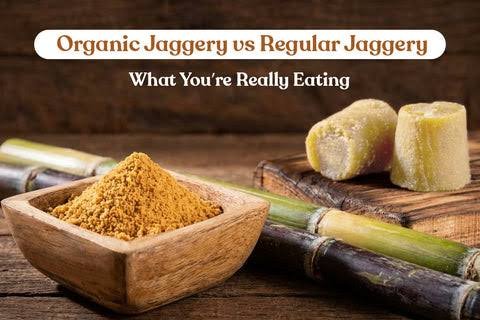
Quick Answer: Organic Jaggery vs Regular Jaggery
The basic difference between organic jaggery vs regular jaggery is how the sugarcane is grown, processed and certified.
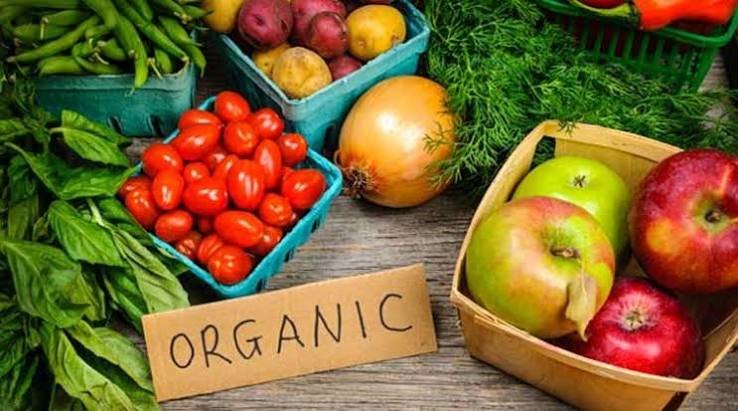
Organic jaggery is made from sugarcane grown under organic farming standards, without synthetic pesticides or chemical fertilisers as per certification rules. Packaged organic jaggery should carry proper organic certification marks, such as Jaivik Bharat, and may also show India Organic or PGS-India Organic depending on the certification system.
Regular jaggery is made from conventionally grown sugarcane. It may still be good quality, tasty and safe if it is made hygienically and sold by a reliable brand or producer. However, regular jaggery may not give you the same traceability or organic certification assurance.
The best choice is not simply the packet that says “organic.” The best choice is jaggery that is properly labelled, not artificially bright, free from added colour, clean in smell and texture, and suitable for how you plan to use it.
Why Jaggery Is Returning to Indian Kitchens
Jaggery is not a new superfood. It is an old Indian kitchen staple that is being rediscovered by younger buyers.
There are a few reasons for this comeback.
First, many people are trying to reduce refined white sugar in their daily routine. Jaggery feels more traditional, earthy and less processed. It has a deeper flavour than sugar, so a small amount can make chai, sweets and winter recipes taste richer.
Second, Indian home cooking is going back to regional ingredients. From Maharashtrian tilgul to Tamil sakkarai pongal, Bengali patali gur sweets, Punjabi panjiri and Rajasthani churma, gur has always had a place in seasonal Indian food.
Third, shoppers are becoming more label-conscious. People want to know where their food comes from, whether pesticides were used, whether colour was added and whether the product is actually natural.
This is exactly why the organic jaggery vs regular jaggery debate matters. It is not just about sweetness. It is about trust.
One important thing to remember: jaggery is still sugar. It may be less refined than white sugar and may have a more complex flavour, but it should still be eaten in moderation, especially by people managing diabetes, insulin resistance or calorie intake.
Organic Jaggery vs Regular Jaggery: Basic Difference
Let us break this down in a simple way.
Organic Jaggery
Organic jaggery is made from organically grown sugarcane. This means the sugarcane should be cultivated according to organic farming rules, without synthetic pesticides and chemical fertilisers. The product should also follow approved handling and processing standards.
Good organic jaggery usually comes with certification details on the pack. It should not simply say “natural,” “pure,” or “farm fresh.” These are marketing words unless backed by certification.
When buying organic gur, look for:
Jaivik Bharat logo
FSSAI license number
India Organic logo or PGS-India Organic logo, where applicable
Clear ingredients list
Manufacturer or packer details
Batch number and date of packing
Best-before date
Storage instructions
Organic jaggery may cost more than regular jaggery because organic farming, certification, small-batch processing and traceability add to the cost.
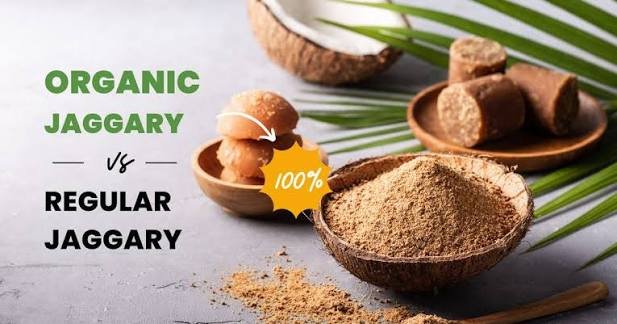
Regular Jaggery
Regular jaggery is made from conventionally grown sugarcane. It is the common gur you find in local kirana stores, mandis, supermarkets and wholesale markets.
Regular jaggery is not automatically bad. Many traditional jaggery makers produce excellent gur. Some regular jaggery may taste better than badly made organic jaggery. The problem is that quality can vary a lot.
Some regular jaggery may be clean and naturally processed. Some may be over-clarified, chemically treated, poorly stored or sold openly without proper hygiene. This is why buyers need to be alert.
The organic jaggery vs regular jaggery choice is not about blindly trusting one and rejecting the other. It is about checking evidence.
Sulphur-Treated Jaggery vs Natural Jaggery
When shoppers ask for chemical-free gur, they are often worried about sulphur-treated jaggery.
Sulphur compounds may be used in some sweetener processing to improve colour and appearance. In the jaggery market, very light yellow or golden jaggery is often viewed with suspicion because consumers associate it with bleaching or chemical clarification.
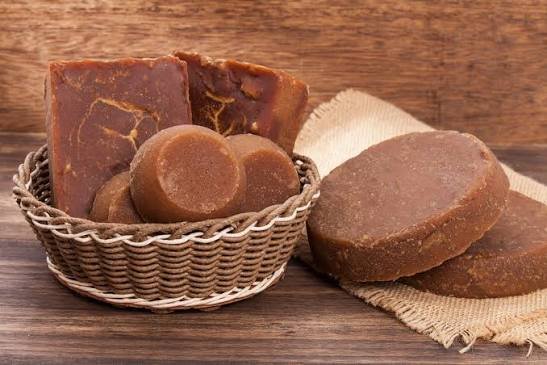
Natural jaggery usually has a deeper colour. It may be golden brown, brown, dark brown or even slightly uneven in shade. It has an earthy smell and a rich sugarcane flavour. It may not look perfectly polished, but that is not always a bad thing.
Sulphur-free jaggery is often marketed as a better option because it avoids sulphur-based treatment. But again, do not trust only the front of the packet. Read the back label.
Look for terms like:
No added colour
Sulphur-free
No synthetic additives
Organic certified
100% sugarcane juice
No preservatives
But remember, claims should be believable and supported by proper labelling. A packet shouting “100% chemical-free” but showing no certification, no FSSAI license and no proper manufacturer details is not a smart buy.
Colour Test: Why Very Bright Yellow Jaggery May Be Suspicious
Colour is one of the easiest ways to judge jaggery, but it is not a perfect test.
Many Indian shoppers believe that the lighter the jaggery, the purer it is. This is not always true. In fact, very bright yellow jaggery can be suspicious, especially if it looks unnaturally shiny or uniform.
Natural jaggery can vary in colour depending on the sugarcane variety, soil, season, boiling method and processing technique. A darker shade does not automatically mean poor quality. Often, darker jaggery has a stronger molasses-like flavour.
A good rule for Indian kitchens is this:
Avoid jaggery that looks too bright, too yellow, too glossy or too perfect.
Choose jaggery that looks natural, earthy and not artificially coloured.
Do not reject darker jaggery only because it does not look pretty.
Good jaggery usually has a pleasant sugarcane smell. It should not smell chemical-like, musty or fermented. If it smells odd, avoid it.
Also check texture. Good block jaggery should be firm but not rock-hard like stone. Powder jaggery should be free-flowing, not damp and clumpy. Liquid jaggery should not smell sour or fermented.
In the organic jaggery vs regular jaggery debate, colour is only one clue. Label, source, smell and storage matter just as much.
Powder Jaggery vs Block Jaggery vs Liquid Jaggery
Jaggery now comes in many forms. Each one has a different use in the kitchen.
Block Jaggery
Block jaggery is the most traditional form of gur. It comes in round, square, dome-shaped or irregular blocks.
Best for:
Chikki
Til laddoo
Gur roti
Panjiri
Winter sweets
Traditional Indian desserts
Melting into syrups
Block jaggery is usually less processed than some powdered varieties, but that depends on the producer. It can be slightly difficult to cut, especially if you use it daily for chai or coffee.
If you cook traditional Indian sweets, block jaggery is a great choice.
Powder Jaggery
Jaggery powder is convenient. It dissolves quickly and is easy to measure.
Best for:
Chai
Coffee
Milk
Porridge
Smoothies
Baking
Quick laddoos
Daily sweetening
Powder jaggery is perfect for modern kitchens where people want convenience. But it absorbs moisture quickly, especially in humid Indian cities like Mumbai, Chennai, Kolkata, Kochi and Goa.
When buying jaggery powder, check that it is not clumpy, wet or sticky inside the pack. Also check whether anti-caking agents or additives are mentioned. If you want chemical-free gur, choose a clean-label powder jaggery with proper certification.
Liquid Jaggery
Liquid jaggery is syrup-like and easy to mix.
Best for:
Payasam
Pongal
Kheer
Pancakes
Dessert drizzling
Marinades
Chutneys
Traditional drinks
Liquid jaggery is convenient but needs careful storage. Once opened, it may need refrigeration depending on the brand’s instructions. Always check the label.
If you want long shelf life, block jaggery is usually easier. If you want daily convenience, powder jaggery wins. If you want easy mixing for desserts and drinks, liquid jaggery is useful.
How to Read Labels Before Buying Organic Jaggery
This is the most important section of the organic jaggery vs regular jaggery guide.
Do not buy organic jaggery only because the front label looks earthy and premium. Turn the pack around and read the details.
1. Check the Jaivik Bharat Logo
For packaged organic food in India, the Jaivik Bharat logo is an important mark to look for. It shows that the product is being sold under India’s organic food framework.
2. Check Organic Certification
The pack may mention India Organic, NPOP certification or PGS-India Organic. These indicate the certification route.
For a normal household buyer, you do not need to become a food law expert. Just remember this simple rule: real organic jaggery should show more than just the word “organic.”
3. Check FSSAI License Number
A packaged food product should mention the FSSAI license or registration number. Avoid packets that look untraceable.
4. Read the Ingredients List
The cleanest jaggery should ideally have one main ingredient: sugarcane juice or sugarcane jaggery.
Be cautious if you see unnecessary additives, artificial colours or vague words. If the packet does not show ingredients clearly, skip it.
5. Check Date of Packing
Freshness matters. Old jaggery can become hard, dry, sticky, fermented or insect-prone depending on storage.
For powder jaggery, freshness is even more important because it absorbs moisture faster.
6. Check the Brand or Producer
Buy from a reliable brand, farmer producer company, organic store, trusted local maker or known cooperative. Random open gur from unknown sources may be cheaper, but it gives you less assurance.
7. Do Not Fall for Big Claims
Words like “desi,” “natural,” “pure,” “village style,” “chemical-free” and “healthy” sound nice, but they are not enough. Always check the label.
Best Uses of Organic Jaggery in Indian Cooking
Organic jaggery can be used exactly like regular jaggery. The difference is that if you are paying extra for certified organic gur, you may want to use it in recipes where the flavour really matters.
Jaggery for Chai
Gud wali chai has a deep, comforting sweetness. Use powdered jaggery or finely chopped block jaggery. Add it after the tea is brewed or on low heat because milk can sometimes split if jaggery is added too early, depending on acidity and impurities.
Jaggery for Laddoo
Til laddoo, peanut laddoo, coconut laddoo, atta laddoo and panjiri taste beautiful with good gur. Block jaggery works best because it melts into a thick syrup that binds the mixture.
Jaggery for Payasam and Kheer
Liquid jaggery or melted block jaggery works well in payasam, kheer and pongal. Add it after cooking the milk or dal-rice base. This helps preserve flavour and texture.
Jaggery for Chikki
For chikki, block jaggery is the traditional favourite. It gives the right texture when melted carefully. Use clean, good-quality gur because the flavour becomes very concentrated.
Jaggery for Winter Foods
In North India, gur is strongly linked with winter. Gur with ghee, gur roti, tilgur, panjiri, gond laddoo, peanut chikki and saunth laddoo all use jaggery beautifully. Organic jaggery is a nice option for these seasonal recipes because the taste is deeper and more earthy.
Jaggery for Daily Sweetening
For everyday use, jaggery powder is the easiest. You can add it to porridge, ragi malt, herbal drinks, lemon water, chutneys and homemade snacks.
Storage Tips for Humid Indian Kitchens
Jaggery storage is a real issue in India. In dry winter weather, gur stays fine. But in humid months, it can become sticky, wet, clumpy or attract ants.
Here is how to store it properly.
Store in an Airtight Container
Once opened, transfer jaggery to an airtight steel, glass or food-grade plastic container. Do not leave it in a loose packet.
Keep Away from Moisture
Moisture is the biggest enemy of jaggery powder. Always use a dry spoon. Do not keep the container near the gas stove, sink or window.
Refrigerate If Needed
In very humid places, you can refrigerate jaggery, especially liquid jaggery or powder jaggery. But keep it tightly sealed so it does not absorb smells from the fridge.
Cut Block Jaggery into Smaller Pieces
If you buy a big block, cut it into smaller pieces and store them separately. This makes daily use easier and reduces repeated handling.
Watch for Insects or Fungus
If jaggery develops visible fungus, strange smell, insects or fermentation, do not use it. It is better to discard it than risk your health.
Do Not Mix Old and New Jaggery
If you buy fresh organic jaggery, do not dump it into a container with old sticky gur. Clean and dry the container first.
Organic Jaggery vs Regular Jaggery: Which One Should You Buy?
Choose organic jaggery if:
You want certified organic ingredients
You are trying to reduce pesticide exposure in daily staples
You prefer traceable food products
You are buying for children or family use
You use jaggery regularly in chai, sweets or snacks
You trust the brand and certification
Choose regular jaggery if:
You have a trusted local source
The jaggery is clean, natural-looking and fresh
You use jaggery occasionally
You want a more budget-friendly option
You can check the product before buying
The best approach is practical. For daily home use, buy the cleanest and most trustworthy jaggery you can afford. Certified organic jaggery is a good option, but regular jaggery from a reliable source can also be suitable.
The real goal is not to buy the fanciest gur. The goal is to avoid poor-quality, artificially coloured, badly stored or untraceable jaggery.
Final Buying Checklist
Before buying jaggery, ask yourself:
Does the packet have a proper FSSAI license number?
If it says organic, does it show Jaivik Bharat or other certification marks?
Is the colour natural, not overly bright yellow?
Does it smell earthy and sweet, not chemical-like or sour?
Is the texture clean and free from visible dirt?
Is the packing date recent?
Are ingredients clearly mentioned?
Is the brand or producer trustworthy?
If most answers are yes, you are probably making a good choice.
Conclusion
The organic jaggery vs regular jaggery debate is not about fear. It is about smart shopping.
Organic jaggery gives you certification, traceability and more confidence about how the sugarcane was grown and handled. Regular jaggery can also be good, but quality depends heavily on the source, processing and storage.
For an Indian kitchen, the safest choice is clean, well-labelled, naturally coloured jaggery from a trusted source. Do not blindly buy the brightest yellow gur. Do not trust only front-label claims like “pure” or “chemical-free.” Read the back of the packet, check certification and store it properly once opened.
Whether you use it in chai, laddoo, payasam, chikki or winter foods, good jaggery can bring warmth, depth and nostalgia to your cooking. Choose wisely, use moderately and let your kitchen enjoy the real flavour of desi gur.
FAQs on Organic Jaggery vs Regular Jaggery
1. What is the main difference between organic jaggery vs regular jaggery?
The main difference is that organic jaggery is made from organically grown sugarcane and should carry proper organic certification. Regular jaggery is made from conventionally grown sugarcane and may not have organic certification.
2. Is organic jaggery chemical-free?
Organic jaggery is produced under organic standards, which restrict synthetic pesticides and chemical fertilisers in farming. But shoppers should still check certification, ingredients and FSSAI details before buying.
3. Is regular jaggery bad for health?
Regular jaggery is not automatically bad. Good-quality regular jaggery from a trusted source can be fine. The concern is with poor-quality jaggery that may be artificially coloured, badly stored or sold without proper labelling.
4. Why is some jaggery bright yellow?
Very bright yellow jaggery may be over-clarified or treated to improve appearance. Natural jaggery is often golden brown to dark brown. Colour alone is not proof, but extremely bright yellow gur should be checked carefully.
5. Which is better: dark jaggery or light jaggery?
Darker jaggery is often closer to the natural colour of gur and may have a stronger flavour. Light jaggery is not always bad, but very bright yellow jaggery can be suspicious. Always check smell, texture, source and label.
6. Is sulphur-free jaggery better?
Many buyers prefer sulphur-free jaggery because it avoids sulphur-based treatment. If you want chemical-free gur, look for sulphur-free claims along with proper certification and labelling.
7. Which jaggery is best for chai?
Jaggery powder is best for chai because it dissolves quickly. Add it on low heat or after brewing to reduce the chance of milk splitting.
8. Which jaggery is best for laddoo and chikki?
Block jaggery is best for laddoo, chikki and winter sweets because it melts well and gives good binding. Choose clean, natural-looking block gur from a trusted source.
9. Does jaggery expire?
Yes, jaggery can spoil if stored badly. It can absorb moisture, become sticky, ferment, attract insects or develop fungus. Always check the best-before date and storage instructions.
10. How should I store jaggery in Indian kitchens?
Store jaggery in an airtight container away from moisture and heat. In humid cities, refrigerate powder or liquid jaggery if needed. Always use a dry spoon.
See Also
Organic Jaggery Vs Chemical Jaggery
Difference Between Adulterated and Pure Palm Jaggery
7 Genius Hacks to Shop Organic on a Budget
Cold Pressed vs Refined Oil: Which is Better for Indian Cooking ?