
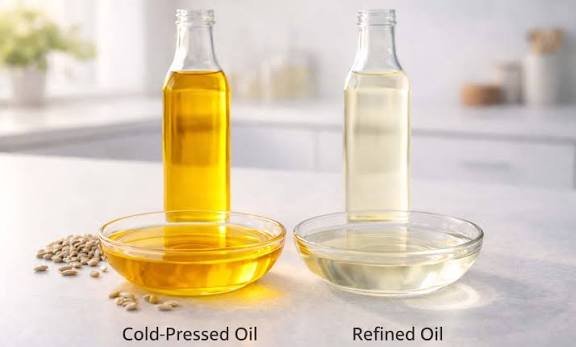
Let’s take a quick trip down memory lane before taking up the debate – Cold Pressed vs Refined Oil. Think back to your grandparents’ kitchen from a few decades ago. Do you remember the distinct, rich aroma that filled the entire house the moment dadi or nani heated oil in an iron kadhai for a comforting Sunday lunch?
Whether it was the pungent kick of pure mustard oil in the North, the sweet, earthy aroma of groundnut oil in the West, or the tropical fragrance of fresh coconut oil in the South—you could literally tell what was cooking from three rooms away.
Fast forward to most modern Indian kitchens today. Look at the plastic bottles or sleek pouches sitting on our kitchen shelves. The oils inside are perfectly clear, completely odorless, and absolutely tasteless. We’ve been conditioned by decades of aggressive television commercials to believe that this clarity is a sign of purity. We’ve been told that these ultra-light, chemically modified fats are the ultimate choice for a healthy heart.
But have you ever paused to ask yourself: How do you take an intensely aromatic, deep-colored seed like mustard or sesame and turn it into a clear, completely scentless liquid that can sit on a supermarket shelf for years without spoiling?
The answer lies in the dramatic battle of cold pressed vs refined oil.
Today, we are stripping away the heavy marketing jargon and diving deep into the actual science of what happens to cooking oil during manufacturing. If you care about your family’s daily wellness, digestion, and systemic health, grab a hot cup of chai, and let’s look at the real truth behind healthy Indian fats.
The Chemistry of Refining: What Happens Behind Factory Doors
To truly appreciate the value of traditional, unrefined fats, we first need to pull back the curtain on the industrial processing of seed oils.
Refined oil isn’t simply filtered oil; it is a highly processed product that undergoes intense chemical and thermal manipulation to maximize manufacturing yields and eliminate natural variations.
                  THE INDUSTRIAL OIL REFINING PIPELINE
  ┌─────────────────────────────────────────────────────────────────┐
  │  HIGH-HEAT EXTRACTION WITH HEXANE SOLVENTS                      │
  ├─────────────────────────────────────────────────────────────────┤
  │  • Step 1: Seeds crushed at high temps; Hexane solvent added    │
  │  • Step 2: Neutralization with Sodium Hydroxide (caustic soda)  │
  │  • Step 3: Bleaching via acid-treated clays to strip color     │
  │  • Step 4: Deodorization under high vacuum at 220°C - 260°C     │
  └─────────────────────────────────┬───────────────────────────────┘
                                    │
                                    ▼
         STRIPPED OF NUTRIENTS, ANTIOXIDANTS, AND NATURAL FLAVOR
               (Leaving behind a structurally altered fat)
When multi-billion-ton factories extract refined oils (like commercial sunflower, soybean, rice bran, or generic “vegetable” oils), they don’t just squeeze the seeds. They use these four aggressive industrial phases:
- Chemical Solvent Extraction: The seeds are crushed and soaked in a chemical solvent called hexane (a petroleum byproduct) to dissolve and extract every single last drop of oil from the seed pulp.
- Neutralization: The raw liquid is treated with harsh alkalines, such as sodium hydroxide (caustic soda), to remove natural free fatty acids.
- Bleaching: The dark, natural color compounds are filtered out using acid-treated clays so the oil looks uniform and clear.
- Deodorization: The oil is heated under a high vacuum to temperatures between 220°C and 260°C to boil away the natural pungent odors.
By the time this process is complete, the oil is effectively dead. The extreme heat and chemical alterations strip away all natural vitamins, trace minerals, and cellular antioxidants, frequently leaving behind trace chemical solvent residues and structurally damaged trans-fats.
The Traditional Resurgence: What Are Kachchi Ghani Oils?
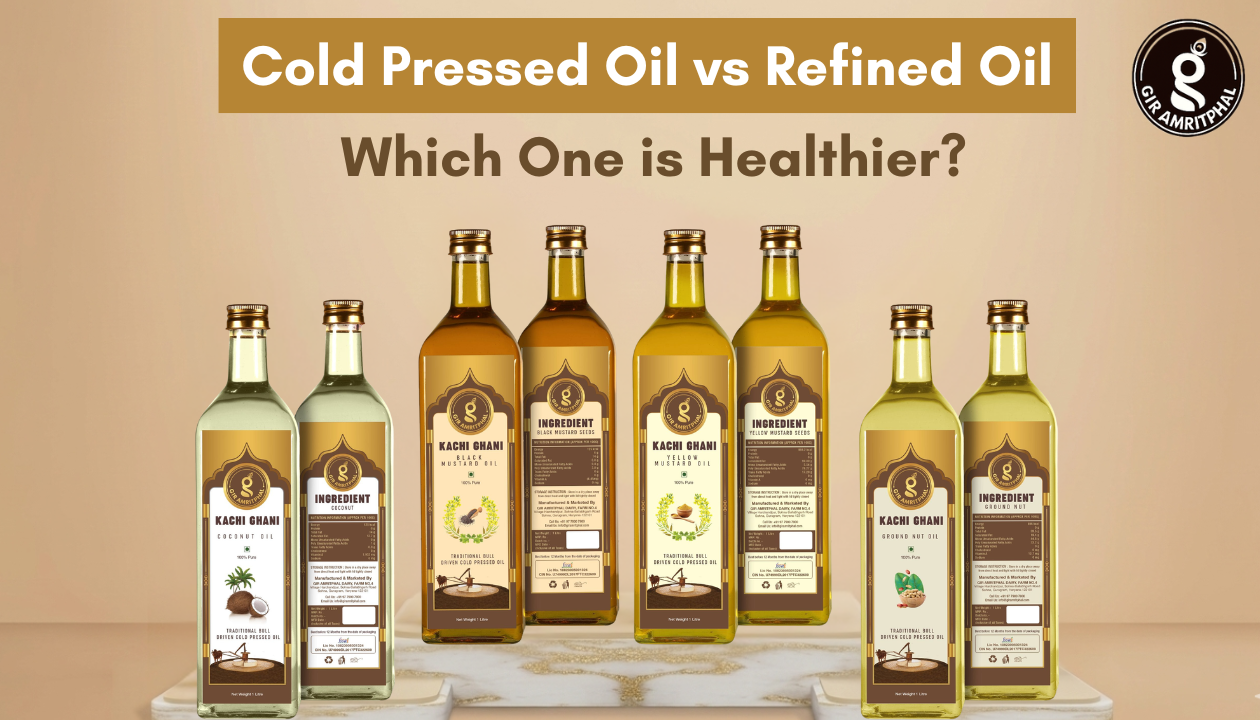
On the completely opposite end of the spectrum lies the traditional Indian method of oil extraction, beautifully known across our land as kachchi ghani oils or wood-pressed (lakdi ghani) oils.
In this ancestral method, clean oilseeds (like mustard, groundnut, sesame, or coconut) are placed inside a heavy wooden mortar and pestle apparatus. The pestle rotates at incredibly slow speeds, mechanically squeezing the seeds to naturally force out the oil.
The magic of wooden churned extraction lies entirely in its temperature management. Because the pestle is made of wood and turns very slowly, it prevents friction heat from building up. The temperature of the oil never rises above 40°C to 45°C.

Because no external heat or chemical solvents are ever introduced, the resulting oil retains its complete cellular profile. The natural proteins, vitamin E, essential fatty acids, and vibrant biological antioxidants remain fully intact, perfectly preserved inside the liquid exactly as nature intended.
The Ultimate Comparison: Cold Pressed vs Refined Oil
To make things incredibly simple for your next household grocery run, let’s look at a clear breakdown of how these two categories stack up against each other across the metrics that matter most:
| Feature & Metric | Cold Pressed / Wood-Pressed Oil | Industrially Refined Oil |
| Extraction Process | Low-speed mechanical pressing using wood/stone. | High-heat crushing combined with petroleum solvents. |
| Nutritional Profile | Extremely high; rich in natural Vitamin E, minerals, and polyphenols. | Low to zero; nutrients are stripped away during chemical bleaching. |
| Chemical Additives | Zero. 100% pure seed extract. | Contains traces of processing agents, preservatives, or anti-foaming chemicals. |
| Natural Aroma & Flavor | Deeply fragrant and specific to the source seed crop. | Completely neutral, tasteless, and odorless. |
| Digestive Impact | Contains natural enzymes that support smooth gut assimilation. | Heavy processing can contribute to low-grade systemic inflammation. |
The Smoke Point Myth: Can You Deep-Fry in Cold Pressed Oils?
Now, let’s address the absolute biggest objection that pops up whenever families consider switching to healthier fats: “But what about the smoke point? Can we safely use cold-pressed variants for deep frying our pakoras and pooris?”
This is where a lot of modern wellness blogs get things wrong by blindly copying Western advice. Many sources state that refined oils are mandatory for high-heat cooking because refining artificially pushes the smoke point higher. While that technical detail is true, it doesn’t tell the whole story.
                       THE HIGH-HEAT HEATING TEST
  ┌─────────────────────────────────────────────────────────────────┐
  │  WHAT HAPPENS WHEN WE COOK AT TRADITIONAL INDIAN TEMPERATURES    │
  ├─────────────────────────────────────────────────────────────────┤
  │  • Refined Oils: High smoke point, but unstable molecularly      │
  │  • Refined Oils: Breaks down easily into toxic polar compounds  │
  │  • Cold-Pressed: Natural antioxidants shield structural fats     │
  │  • Cold-Pressed: Stays highly stable during traditional frying   │
  └─────────────────────────────────┬───────────────────────────────┘
                                    │
                                    ▼
                SUPERIOR STRUCTURAL INTEGRITY & HEART SAFETY
When evaluating high smoke point cooking fats, what matters most is oxidative stability—how well the oil’s molecular structure holds up under continuous heat without breaking down into harmful free radicals.
Refined oils lack natural antioxidants, meaning that when you heat them for deep frying, they degrade rapidly into toxic polar compounds. On the other hand, traditional cold-pressed oils are packed with natural protective compounds that act as physical shields, keeping the fat incredibly stable even under intensive frying conditions.
The Cold-Pressed Temperature Guide
- Cold-Pressed Mustard Oil: Features a natural smoke point of around 250°C, making it absolutely exceptional for deep frying, heavy sautéing, and intense North Indian tadkas.
- Cold-Pressed Groundnut Oil: Offers a natural smoke point near 225°C to 230°C. It is an absolute favorite for deep frying across western and southern states because it doesn’t absorb food flavors or break down easily under heat.
A Regional Blueprint for Healthy Indian Fats
One of the most beautiful aspects of traditional Indian food systems is how perfectly tailored they are to our local regional micro-climates. You don’t need to import expensive extra virgin olive oil from Europe to stay healthy. Your body is biologically primed to thrive on the traditional fats that your ancestors consumed for generations in your specific region.
Let’s look at the three regional powerhouses that deserve a permanent spot in your home:
1. Cold-Pressed Mustard Oil Benefits (Sarson ka Tel)
- The Profile: A beautiful, dark golden oil with a signature pungent aroma and a sharp, warming bite.
- Health Impact: Features an ideal balance of Omega-3 and Omega-6 fatty acids. It contains powerful monounsaturated fats that support long-term heart wellness and actively boost digestive juices in the stomach.
2. Cold-Pressed Groundnut Oil (Moongfali ka Tel)
- The Profile: Light golden, subtly sweet, and beautifully nutty.
- Health Impact: Incredibly rich in plant sterols and vitamin E. Because it is highly stable, it serves as the ultimate all-purpose foundation for daily Indian cooking, from sabzis to deep-fried festive snacks.
3. Cold-Pressed Coconut Oil (Nariyal ka Tel)
- The Profile: Crystal clear when liquid, intensely tropical, and incredibly clean.
- Health Impact: Packed with Medium Chain Triglycerides (MCTs), primarily lauric acid. Unlike other fats, MCTs are processed directly by the liver, giving your body a clean, rapid burst of energy while supporting excellent gut health.
Making the Transition Smoothly and Sustainably
If you are ready to upgrade your kitchen using our cold pressed vs refined oil roadmap, use this practical sequence to make the transition simple without breaking the bank:
1.The High-Heat Upgrade:Phase 1.
Start by replacing your primary deep-frying and high-heat cooking oil. Swap out your commercial refined sunflower or soybean oil for a high-quality, cold-pressed groundnut oil or kachchi ghani mustard oil. This single change eliminates the most damaged fats from your family’s daily diet.
2.Adjust Your Visual and Sensory Expectations:Phase 2.
When you start cooking with authentic cold-pressed oils, remember that less is more. Because these oils are unrefined and dense, you will need roughly 20% to 30% less volume compared to thin, watery refined oils to achieve the exact same cooking results. Don’t be alarmed if the oil foams slightly when you add veggies—that is a natural sign of living, unbleached proteins!
3.Integrate Pure A2 Ghee for Finishes:Phase 3.
Complement your new cold-pressed oils by using pure, traditional A2 cow ghee for low-heat finishes, like brushing warm rotis, topping hot dal khichdi, or assembling evening snacks. Ghee and cold-pressed oils together form the ultimate ancestral wellness duo.
Reclaim the Soul of Your Kitchen
Choosing between cold pressed vs refined oil isn’t just a minor dietary preference; it is a profound choice to step away from industrial food manipulation and return to genuine, unadulterated nourishment.
When you introduce real, cold-pressed oils into your daily routine, you aren’t just upgrading your health markers. You are reclaiming the rich flavors, incredible aromas, and deep nutritional heritage of the traditional Indian kitchen.
Take it one step at a time. Start with a single bottle of wood-pressed oil this month, let your family experience the incredible difference in flavor and vitality, and watch your kitchen transform into a true sanctuary of health!
Let’s Celebrate Local Traditions!
What traditional cooking oil did your family use when you were growing up? Have you made the switch to cold-pressed or wood-pressed oils recently, and did you notice a difference in your digestion or energy levels? Drop your stories and kitchen tips in the comments below—let’s connect and learn together!
See Also
Cold-Pressed Oils Vs Refined Oils | Which Is Better & Why?
Is Organic Food More Nutritious? What Science Honestly Says